I first saw a moose in Sweden on a Tuesday morning in late August, on a gravel road outside Mora in Dalarna. I'd been driving slowly, windows down, through a stretch of birch forest just starting to turn, when it stepped out of the trees perhaps twenty metres ahead. A cow moose — a female, no antlers — standing in the middle of the road with the particular quality of indifference that very large animals can afford. She regarded the car for perhaps ten seconds, snorted once, and walked into the trees on the other side at a pace that suggested she had better things to do.
I sat in the car for another minute, doing nothing in particular, feeling the specific kind of excitement that comes from encountering something large and wild and entirely unconcerned with your presence. I've been back to Sweden six times since. I've seen moose on every single trip.
Why Sweden is One of Europe's Best Wildlife Destinations
Sweden has one of the richest temperate wildlife populations in Europe, and it occupies a country that has retained the habitat to support it: 63% forest cover, 97,500 lakes, hundreds of thousands of square kilometres of bog, mountain and boreal wilderness that large mammals, birds of prey and apex predators need to thrive. The megafauna of Scandinavia — animals that were driven to extinction across most of western Europe centuries ago — are here, in real numbers, roaming forests and mountains that are accessible to anyone willing to look.
What This Guide Covers
This guide covers the major species: what they are, where they live, when to see them, and what a realistic encounter actually looks like. It starts with the animals most likely to be seen and ends with the ones that require dedication, luck or both.
At a Glance: Sweden's Wildlife by Region and Difficulty
Before planning, know what's realistic. This table is honest about which animals you're likely to see versus which require serious effort — and where to go for each.
| Animal | Best Region | Best Season | Realistic Chance | Guided Tour Price |
|---|---|---|---|---|
| 🫎 Moose | Dalarna, Värmland, Bergslagen | May–Oct (dusk/dawn) | High — very common | 300–600 kr/person |
| 🐻 Brown bear | Dalarna (Orsa/Bjurfors), Jämtland | May–Oct | High on guided hides | 1,500–3,000 kr/person |
| 🐺 Wolf | Bergslagen (Dalarna/Värmland) | Winter (tracks in snow) | Low sight; tracks likely | 2,000–4,500 kr/person |
| 🐱 Lynx | Jämtland, Norrland | Winter (tracks) | Very low; tracks medium | Contact specialists |
| 🦌 Reindeer | Swedish Lapland, Norrbotten | Year-round | Very high | Free (roadside sightings) |
| 🦡 Wolverine | Jämtland mountains, Lapland | Winter | Very low; tracks possible | 3,000–7,000 kr/person |
| 🦅 White-tailed eagle | Archipelago, Hornborgasjön, Kullaberg | Year-round (best winter) | High near nest sites | Free (public sites) |
| 🦭 Grey seal | Bohuslän, Stockholm Archipelago | Year-round | High (kayak tours) | Kayak hire 500–900 kr |
Mistakes Tourists Make When Wildlife Watching in Sweden
❌ Arriving at the wrong time of day
Most people exploring Sweden's forests do so between 10am and 3pm — the worst possible window for wildlife. Moose, bears, deer and most birds are most active at dawn (30 minutes before sunrise) and dusk (around sunset). If you want to see something, you need to be in position before the light. This means getting up early. Nobody who has sat in a forest clearing at 5am in a Swedish August has regretted it.
❌ Staying on the main roads
Trunk roads carry too much traffic for moose and deer to feel comfortable. The forest roads — gravel tracks leading to logging operations, summer farms, lake access points — are where wildlife sightings happen. On any OS-style map of Sweden, these are shown as dashed lines. Drive them slowly at dawn and dusk. The Dalarna forest roads north of Mora and east of Malung are among the most productive in the country.
❌ Expecting guaranteed sightings without guidance
Wild animals are unpredictable. A guided moose safari dramatically improves your odds because guides know the specific water sources, forest clearings and feeding routes that animals use repeatedly. Random driving through forest, however beautiful, is a lottery. If seeing a specific animal matters to you — particularly bears or wolves — book a specialist guided session rather than hoping. The odds difference is significant.
❌ Making too much noise
Sweden's forests are quiet. Human conversation, footsteps on dry leaves, the sound of a car door — all carry further than you'd expect in still air. Experienced wildlife watchers move slowly, speak in whispers, and stop frequently to listen. The sounds that tell you wildlife is near — a branch cracking, the alarm call of a jay, the sudden silence of other birds — are inaudible if you're generating noise yourself.
❌ Underestimating the mosquito situation
This is not a minor point. The Scandinavian forest mosquito (Aedes) is abundant, persistent, and indifferent to weak repellents from June through August, particularly near water. Experienced Swedish outdoor people use DEET-based repellents of 30–40% concentration and cover all exposed skin. Wildlife watching sessions at dawn and dusk — the most productive times — happen to coincide exactly with peak mosquito activity. Come prepared or suffer.
Recommended Wildlife Operators
🐻 Bear Watching — Dalarna
Orsa Grönklitt (orsagrönklitt.se) — The Orsa Bear Park offers ethical viewing of bears in a large natural enclosure. Not wild but genuinely excellent and a reliable option when schedule doesn't allow a multi-evening wait. Tickets around 200 kr adults.
Naturguide Dalarna — One of several operators in the Bjurfors area running guided wild bear sessions from hides. Book through the local tourist office at Mora or search "björnpass Dalarna." Sessions typically run 6–10pm and cost 1,500–2,500 kr/person.
🫎 Moose Safaris
Mooseworld, Orsa — One of the longest-established moose safari operations in Sweden. Evening drives with a guide through forest road networks with extremely high sighting rates. About 450 kr/person.
Älgsafari i Värmland — Multiple operators in the Åmål and Torsby area of Värmland run evening safaris through some of the highest-moose-density forest in Europe. Ask your accommodation to book — local guides are the best source.
DIY option: Rent a car, drive forest roads around Mora, Malung or Filipstad between 5:30–7:30am. Drive slowly. Keep the windows down. You have a reasonable chance without paying anything.
🐺 Wolf Tracking — Bergslagen
Wild Sweden (wildsweden.com) — The most established specialist wildlife tour operator in Sweden, running multi-day wolf tracking trips in winter Bergslagen as well as bear, lynx and wolverine expeditions. Not cheap but genuinely expert. Multi-day wolf trips from around 8,000 kr/person.
Nature Travels (naturetravels.co.uk) — UK-based operator specialising in Scandinavian wildlife, with wolf and bear packages in Sweden. Good for UK visitors who want everything arranged in one booking.
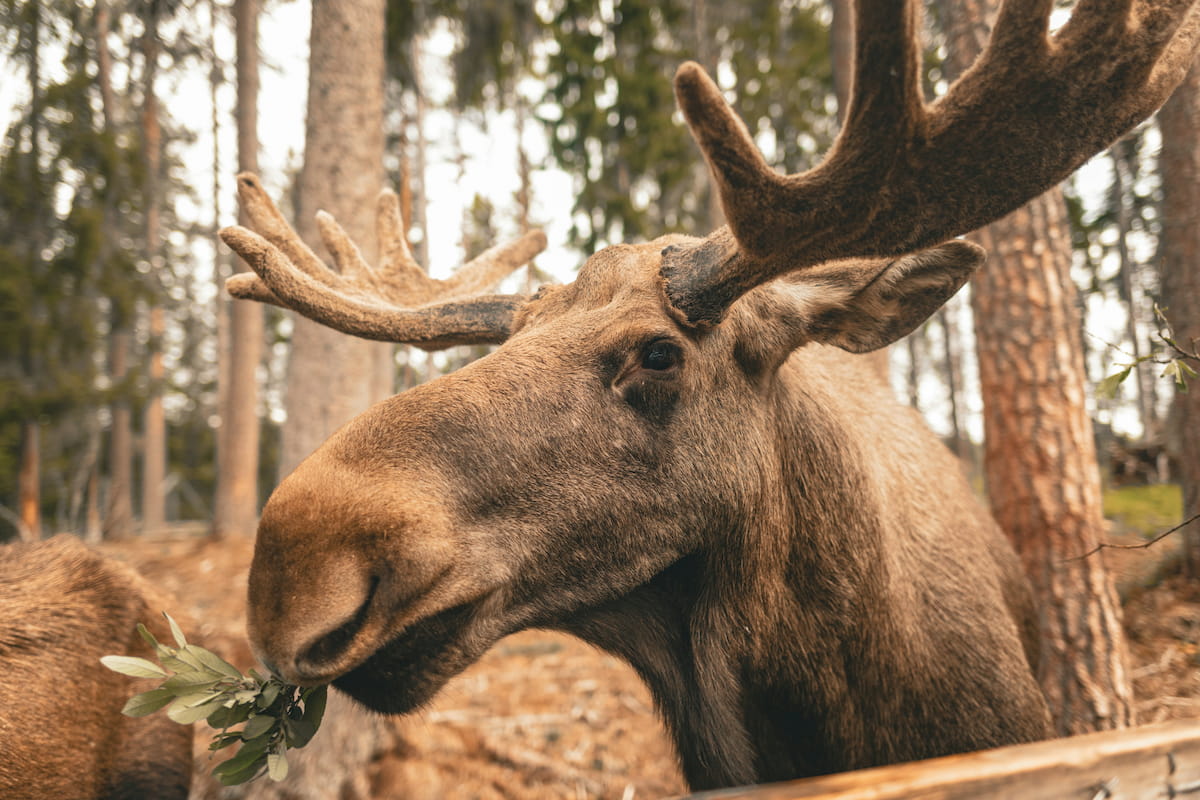
The Moose: Sweden's Defining Animal
Alces alces — Älg in Swedish
Sweden has the highest density of moose of any country on Earth. There are approximately 400,000 of them — about one for every 26 people — and in autumn, after calves are born in spring and before the hunting season reduces numbers, the population temporarily swells higher still. The moose is not a background creature in Sweden. It is a presence. Road signs warn of them. Farmers fence against them. Hunters pursue them in October with a seriousness that constitutes a second national religion. The country kills around 100,000 moose annually in a strictly controlled cull designed to keep the population in balance with forest regeneration — and the population remains stable. That tells you something about the scale of what's out there.
A bull moose in full antler — which begins developing in spring and reaches its maximum in August and September before being shed in November — is one of the most physically impressive sights in the natural world. The antlers of a mature bull can span 180 centimetres and weigh 20 kilograms. The animal itself stands 2.1 metres at the shoulder and can weigh 700 kilograms. It is, by a significant margin, the largest land animal in Europe.
Despite their size, moose are not easy to see in dense forest. They are browsers rather than grazers — they eat leaves, twigs and aquatic vegetation rather than standing in open fields — which means they spend most of their time inside the forest edge rather than in open terrain. The best time to see them is at dawn and dusk when they move to forest clearings, roadsides, lake edges and river valleys to feed. In summer they frequently wade into lakes and rivers to eat aquatic plants and escape the heat and the insects. Seeing a moose standing chest-deep in a lake, calmly pulling up water plants with a nose that looks slightly too large for even its considerable face, is one of the stranger and more wonderful sights Swedish nature produces.
Where to find them: essentially anywhere in Sweden outside the major cities. Dalarna, Värmland and the forests of Bergslagen have particularly high densities. Moose safaris — guided evening drives through forest roads with an experienced naturalist — are offered throughout the country and dramatically improve your odds over random driving. The area around Åmål in Värmland and the forests north of Sundsvall are regarded among the best. Drive any forest road in Sweden at 6am or 8pm in July and August and you have a reasonable chance without a guide. Drive carefully: collisions with moose are one of the most serious road hazards in the country, causing several hundred serious accidents annually.
🚗 Moose Safari vs. Driving Your Own Route
Guided moose safaris (offered throughout the country, typically 300–600 SEK per person) use local knowledge of regular feeding routes and water sources that random driving doesn't have. Guides can also read the forest edges and recent signs in ways that a first-time visitor cannot. That said, moose on roadsides at dawn are genuinely common in the right regions — if you're renting a car and driving through forested areas, keep your speed down and your eyes on the verges from about 30 minutes before sunrise.
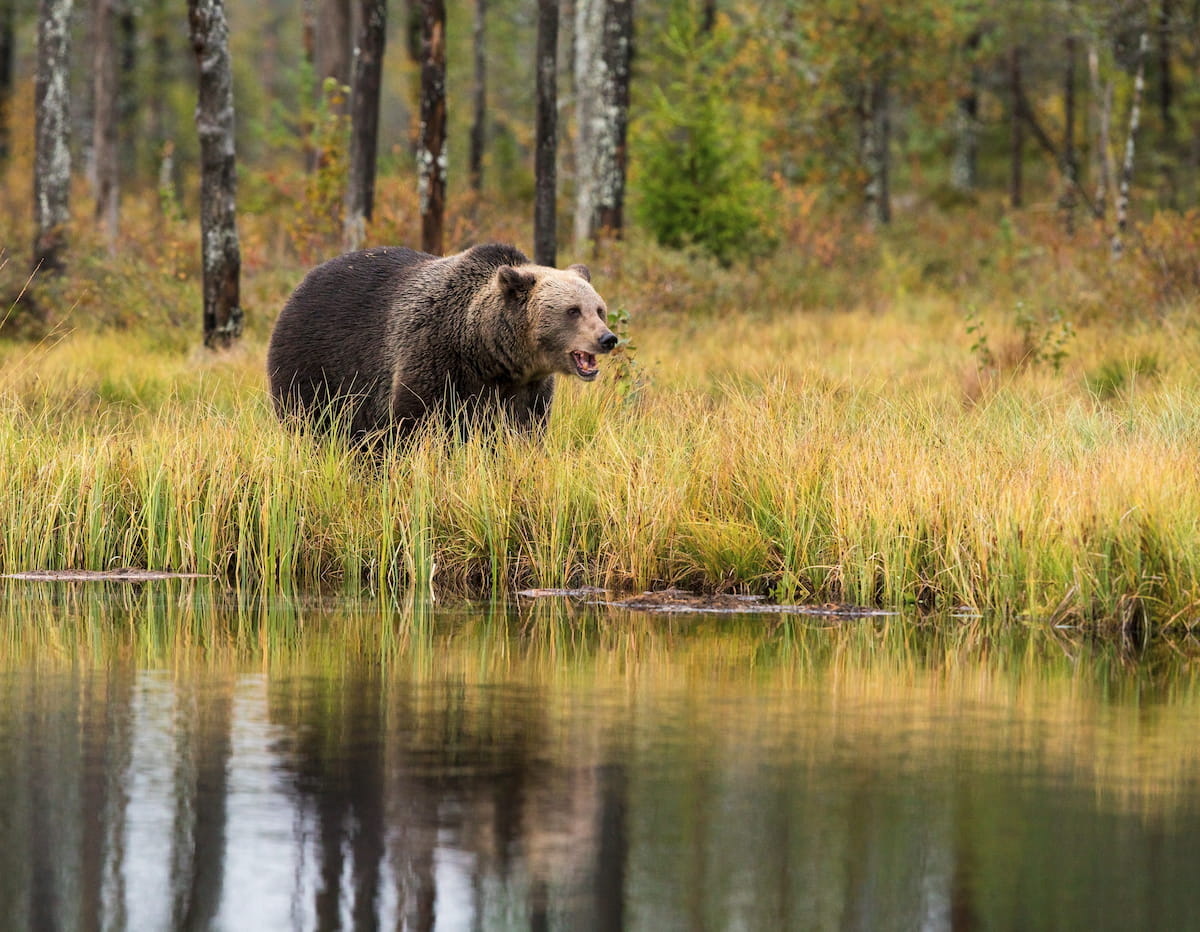
The Brown Bear: Large, Elusive and Genuinely Wild
Ursus arctos — Björn in Swedish
Sweden has the second-largest brown bear population in Europe, after Russia. Approximately 3,000 bears live primarily in the boreal forests of Norrland — the vast northern half of the country — with the highest densities in Dalarna, Gävleborg, Jämtland and the forests of Norrbotten. These are not the habituated bears of Yellowstone or the Carpathians, where tourist pressure has made them somewhat accustomed to people. Swedish brown bears are genuinely wild. They are shy, solitary and — outside of rare defensive encounters — fundamentally uninterested in humans. Which is both why they're safe to be around and why seeing one requires real effort.
A bear in the Swedish forest is typically aware of you long before you're aware of it, and has usually moved away by the time you reach where it was. Bears have exceptional olfactory senses — they can smell a human from several kilometres downwind — and their default response to that smell is to leave quietly. The bears that are occasionally seen from forest roads or at forest edges are typically young animals that haven't yet learned the adult's extreme caution, or bears in late summer focused intensely on eating enough to survive hibernation.
Bear watching as a planned activity is concentrated around a handful of specialist operations in Dalarna and Jämtland. The method is a high seat (elevated blind) positioned near a natural bear feeding area, typically in the evening. You sit, silently, for several hours. Sometimes a bear comes. Sometimes it doesn't. When it does — emerging from the tree line, testing the wind with its long mobile nose, moving with that particular weight-forward gait that looks slow until you realise it could cover the open ground between you and the forest in about four seconds — it is one of the most significant wildlife encounters available anywhere in Europe.
Bjurfors and the forests around Orsa in Dalarna host several reputable operations. The Orsa Bear Park (Orsa Björnpark) offers a guaranteed viewing experience with semi-wild bears in a large enclosure — it's not the same as a wild encounter, but it's a credible and ethical alternative if your schedule doesn't allow a multi-evening wait. For the wild version, book guided sessions through operators in the Dalarna or Jämtland forest areas, where local guides have spent years learning individual bears' patterns and are straightforwardly honest about how reliably they appear.
🐻 Bear Safety in the Swedish Forest
Swedish bears very rarely attack people — there have been fewer than ten serious bear incidents in Sweden in the past fifty years, and most involved dogs or hunters in close contact. Standard advice: make noise while hiking so bears hear you coming, don't leave food out at camp, avoid approaching a sow with cubs, and if you encounter a bear at close range, speak calmly, back away slowly and do not run. The bear will almost certainly go first. Carrying bear spray is not common practice in Sweden but is reasonable in areas of known high bear density.
The Wolf: Sweden's Most Controversial Animal
Canis lupus — Varg in Swedish
The wolf was hunted to extinction in Sweden in the 1960s. Its return — from a founding population of Finnish and Russian wolves that crossed the border in the early 1980s — is one of the most significant and contentious wildlife stories in modern Swedish history. Today there are approximately 460–500 wolves in Sweden, organised in roughly 50 packs, centred primarily on the Bergslagen forest region that covers parts of Dalarna, Värmland, Örebro and Västmanland counties. The reintroduction has been bitterly contested — between farmers and reindeer herders who suffer real losses, and conservationists and ecologists who argue for the wolf's essential ecological role. It remains a live political debate.
Actually seeing a wild wolf in Sweden is extremely unlikely without a specialist guide and a great deal of patience. Wolves maintain enormous territories — a single pack may range over 1,000 square kilometres — and they are, even more than bears, constitutionally averse to human presence. They are also mostly nocturnal in areas where human activity is high. The realistic wolf experience for most visitors is not a sighting but a sign: tracks in winter snow, a howl heard at dusk from a forest road, the particular quality of silence that descends on a forest when a pack is near and the other animals know it.
Wolf-watching trips in winter, following fresh tracks with an experienced guide in the Bergslagen forests, are offered by a small number of specialist naturalist operators. The tracks themselves — large, almost hand-sized, with the characteristic direct-register gait that leaves a near-straight line rather than the paired tracks of a dog — are extraordinary to find and follow. Hearing a wolf howl at night, which guides can sometimes provoke with a response call, is one of those experiences that changes your relationship with the concept of wild in a fundamental way.

The Lynx: Invisible and Everywhere
Lynx lynx — Lo in Swedish
Sweden has approximately 1,500 Eurasian lynx — the largest lynx population in the EU — distributed across the boreal forest zone that covers most of the country. The lynx is the most elusive large predator in Europe. It hunts alone, moves silently, covers enormous distances at night, and has the particular gift of being absolutely there and absolutely invisible simultaneously. Many Swedish foresters who have worked in the same forests for decades have never seen one. The lynx is present in almost every significant forested region of the country. The fact that it is almost never encountered is a product of its behaviour rather than its rarity.
Signs of lynx are more accessible than the animal itself. The distinctive large, round, clawless (retractile) tracks in snow are unmistakable once you know what you're looking for. Lynx prey primarily on roe deer, and their kill sites — a deer carcass with the characteristic consumption pattern of a large cat — are found regularly by hunters and foresters in areas of high lynx density. The mountain forests of Jämtland and the extensive spruce forests of Norrland are the best regions.
Dedicated lynx watching through specialist naturalist operators does exist and occasionally produces results, particularly in the weeks after fresh snowfall when tracks are readable and the lynx's hunting activity is at its most visible. But the honest assessment is that a lynx sighting in Sweden is genuinely rare even for people actively searching. When it happens — the animal materialising briefly at a forest edge, then simply not being there the moment you look away — it is the kind of experience that defines what wildlife watching is actually about.
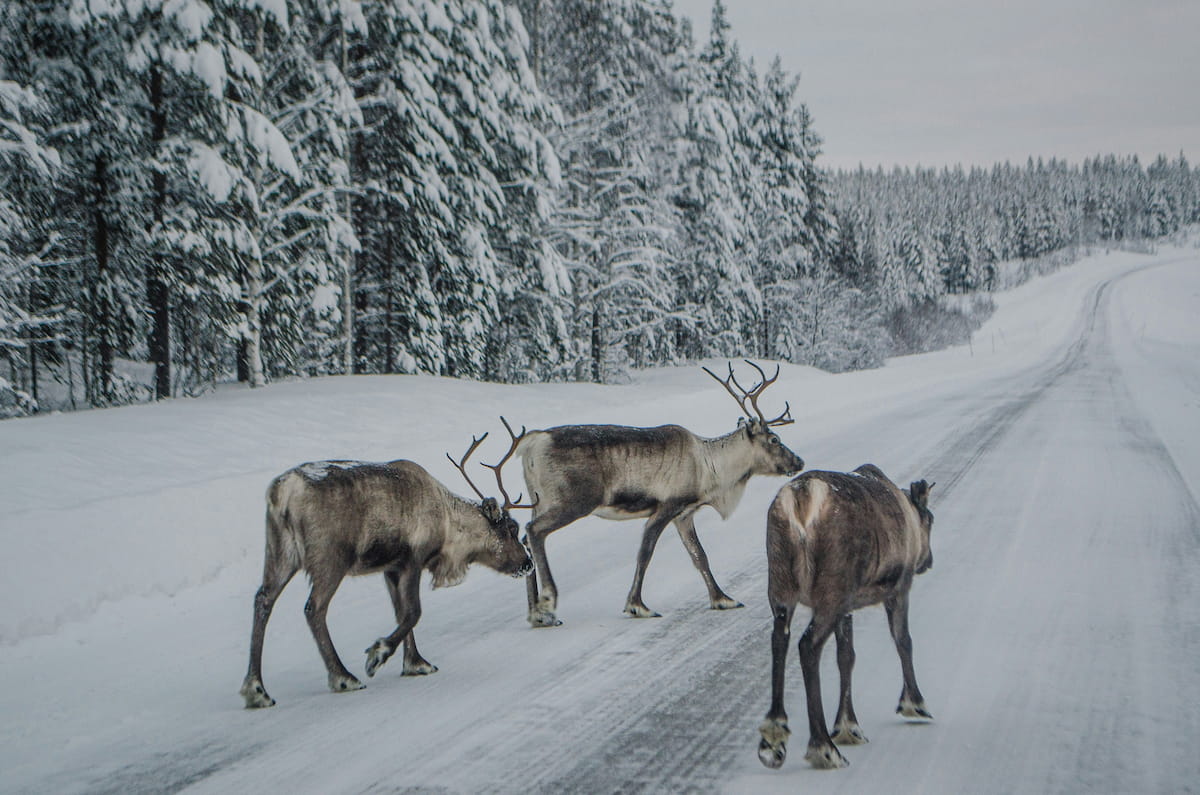
Reindeer: The Arctic Constant
Rangifer tarandus — Ren in Swedish
Reindeer in Sweden occupy a legal and cultural category that has no real equivalent in western European wildlife. They are not wild — they are owned, herded and managed by the Sami people, whose rights to reindeer herding are protected by both Swedish and EU law. But they live freely across enormous areas of Lapland and northern Norrland, moving between seasonal pastures with only occasional human intervention. In practical terms, the experience of encountering them on a mountain trail or a forest road feels entirely wild, even if ownership documents exist somewhere for the specific animal standing in your way.
In Lapland, reindeer are simply part of the landscape in all four seasons. In winter, herds gather around wind-blown ridges where snow cover is thin enough to dig through to the lichen beneath, and are often encountered on roads and trails around Abisko, Kiruna and Jokkmokk. In summer, herds move to higher mountain terrain and are a constant presence on the Kungsleden trail and the mountain pastures of the Scandinavian range. The animals show no particular fear of people — they have lived alongside Sami herders for thousands of years — but they don't seek contact either. They exist in a kind of parallel world that occasionally intersects with yours.
Encountering a reindeer herd on the Kungsleden high passes in August — perhaps two hundred animals moving slowly across a mountain flank, the older cows leading, the calves of the year still slightly uncertain on their legs, the whole group trailing that particular sweet smell that Sami people say you never forget — is one of the experiences that makes the high north feel like a genuinely different world from the urbanised south.
The Jokkmokk Winter Market, held every February since 1605, is the oldest and most important Sami market in Sweden and brings together Sami culture, crafts, food and reindeer in a way that provides real context for what the relationship between these people and these animals actually means. It's one of the most worthwhile cultural events in Scandinavia and makes an excellent anchor for a Lapland winter trip.
The Wolverine: Ghost of the High Mountains
Gulo gulo — Järv in Swedish
The wolverine is the rarest and least-known of Sweden's large predators, and also — by most accounts of those who study them — the most impressive pound-for-pound. An animal that weighs 15 kilograms and looks, at first glance, like a sturdy brown dog, the wolverine can kill reindeer, cache food under deep snow, travel 50 kilometres in a single day, and climb near-vertical cliff faces that would challenge a skilled human mountaineer. It lives in the remote mountain and sub-alpine zone along the Norwegian border, from Jämtland north through Lapland, and it is almost never seen. Most wildlife photographers who have spent years trying to photograph one in the wild have not succeeded.
Wolverine tracks in deep mountain snow are the most realistic encounter for most visitors. The distinctive bounding gait leaves a paired imprint with a characteristic loping gap between each pair — quite unlike anything else in the mountain environment. Finding wolverine tracks on a backcountry ski tour in the Jämtland mountains in March is a genuinely thrilling moment, partly because of what the animal is and partly because of the knowledge that it was here, moving through this terrain that humans find challenging, at a pace we can't approach.
A handful of specialist wildlife operators in northern Jämtland and southern Lapland offer multi-day wolverine tracking trips in winter, following sign in the snowpack. Encounters are not guaranteed — they never are with an animal this elusive — but the landscape the search takes you through, and the cumulative understanding of mountain ecology it builds, make these trips worthwhile regardless of outcome.
The White-Tailed Eagle: Return from the Brink
Haliaeetus albicilla — Havsörn in Swedish
The white-tailed eagle — Europe's largest bird of prey, with a wingspan that can reach 2.5 metres — was brought to the edge of extinction in Sweden by the 1970s through hunting and DDT poisoning of its prey. A sustained protection and reintroduction programme, begun in 1971, brought it back. Today Sweden has approximately 700 breeding pairs — the largest population in western Europe and one of the great conservation success stories of the twentieth century. The recovery of the white-tailed eagle is, in a meaningful sense, a demonstration of what wildlife protection can achieve when it is taken seriously over a long time horizon.
The white-tailed eagle is now genuinely common in Sweden — not in the sense that you trip over them, but in the sense that anyone spending time near large lakes, the Baltic coast or the archipelago in summer, or frozen lake margins in winter, has a realistic chance of seeing one. They are most visible in winter, when they congregate around stretches of open water and areas where deer carcasses provide carrion. The Kvismaren wetland reserve near Örebro, the Hornborgasjön lake in Västergötland, and the Kullaberg peninsula in Skåne are among the best viewing sites.
A white-tailed eagle in flight is an unmistakable sight. The size differential from a buzzard or even an osprey is immediate and startling. The wedge-shaped tail that gives the species its name, visible from far below, and the heavy, almost languid wingbeat of an animal that weighs eight kilograms and doesn't need to hurry — once seen, the species is never confused again. Breeding pairs return to the same nest every year, and many nest sites in the archipelago and along the Norrland coast are known to local birders who can point you directly at active nests from a respectful distance.
Other Species Worth Knowing
🦬 The European Bison – Wisent
A small herd of European bison, the continent's largest land animal, lives in Eriksberg Nature Reserve in Blekinge in southern Sweden. Driven to extinction in the wild in 1927, the species was brought back through a captive breeding programme and now exists in semi-wild populations across several European countries. Eriksberg allows visitors to observe the bison alongside wild boar, fallow deer and other species in a large fenced reserve on a peninsula of forest and meadow. It is the easiest place in Scandinavia to see bison at close range.
🦭 The Grey Seal
Sweden's coasts support large populations of grey seals, with haul-out sites throughout the Baltic, the Öresund and the Bohuslän archipelago. The islands around Gåsö in Bohuslän and the outer Stockholm archipelago are particularly good. Grey seals are large — males can weigh 300 kilograms — and surprisingly fast in the water. A seal surfacing three metres from your kayak to investigate the strange yellow thing passing through its territory is a regular occurrence in the outer archipelago and a reliable delight throughout.
🦁 The Golden Eagle
Sweden has approximately 600 breeding pairs of golden eagles, concentrated in the mountain and sub-alpine zone of Lapland and the Scandinavian range. The northern section of the Kungsleden trail passes through an area with one of the highest golden eagle densities in Scandinavia, and soaring birds are a regular sight above the high passes in July and August. The species also nests in the deep boreal forests of Norrland, where the large nest platforms — sometimes used for decades — are occasionally visible from forest roads.
🦢 The Whooper Swan
The whooper swan is the national bird of Finland but large numbers breed in Sweden's northern lakes and wetlands and migrate through in spring and autumn. The sight of a family group of whooper swans — the large white adults and their grey cygnets from the year — on a still Lapland lake in August, with the forest reflected in the water around them, is one of those scenes that burns itself into memory and explains better than any description why people travel specifically to see birds.
🐗 The Wild Boar
Wild boar were absent from Sweden for centuries, hunted to local extinction before records began. They began spreading northward from Denmark in the 1980s and are now present across most of Skåne, Blekinge, Halland and increasing areas of central Sweden. They are the fastest-expanding large mammal in the country, and opinions on them range from agricultural alarm to genuine delight. Rooting signs — areas of churned earth where a sounder has dug for roots and bulbs — are ubiquitous in deciduous forest in the south. The animals themselves are nocturnal and cautious but occasionally visible at forest edges at dusk in areas of high density.
The Right Regions for Wildlife
Sweden's wildlife is not evenly distributed, and knowing which regions specialise in which species makes planning far more productive.
Lapland is the destination for reindeer, wolverine, arctic fox, snowy owl (in irruption years), rough-legged buzzard, long-tailed duck, and the full complement of Scandinavian mountain birds. It is also the northernmost extent of the brown bear and wolf ranges. The light and the landscape make any wildlife encounter here feel more significant — there is no backdrop of agricultural Europe, no pylons or roads, just the mountain and the animal and you.
Dalarna and Bergslagen are the best regions for moose (extremely high density), brown bear (several quality viewing operations), wolf (the core Swedish wolf range runs through Bergslagen), and elk calves in May. The forest here is old enough and undisturbed enough that large mammals can move freely and comfortably. It is also beautiful forest — older and more varied than the commercial spruce plantations of some other regions.
The Bohuslän coast and Stockholm archipelago are the best regions for marine mammals — grey seal, harbour porpoise (increasingly common in the outer archipelago), and occasional minke whale in Bohuslän's outer waters. White-tailed eagle is excellent in both regions. The Kullaberg peninsula in Skåne combines white-tailed eagle, grey seal hauled out on rocks below the cliffs, and the best seabird watching in southern Sweden.
The wetlands of Hornborgasjön and Kvismaren in central Sweden are among the finest bird-watching sites in Scandinavia. Hornborgasjön, in Västergötland, hosts up to 20,000 migrating common cranes in April — one of the great wildlife spectacles of northern Europe — alongside nesting white-tailed eagles, ospreys, great grey owls and a full roster of wetland birds. The crane migration is a planned event: visitors come from across Europe specifically for it.
📚 Useful Resources for Swedish Wildlife
Artfakta (artfakta.se) — the Swedish Species Information Centre's database of all Swedish species, with distribution maps and observation records. Artportalen (artportalen.se) — the national wildlife observation recording system, where anyone can report and view sightings. A search for any species in any region shows recent observations with map locations. The Swedish Society for Nature Conservation (Naturskyddsföreningen) runs guided nature walks throughout the country; their calendar is a reliable way to find quality local wildlife guidance wherever you're based.
Wildlife and the Swedish Seasons
Sweden's wildlife follows the seasons as visibly and dramatically as any aspect of the country's character. Spring brings the crane migration — that April spectacle at Hornborgasjön, 20,000 birds on a single lake — and the emergence of bears from hibernation, the birth of moose calves in May, the arrival of migratory birds in enormous numbers. The swifts come to Swedish towns in mid-May and their screaming aerial circuits mark the true beginning of summer as surely as any calendar date.
Summer is the quietest time for wildlife watching in some ways — animals are deep in the forest, breeding, feeding, raising young — but it is the season when incidental encounters are most common for casual visitors: moose by roadsides in the evening, reindeer on mountain trails, white-tailed eagles over archipelago waters, beavers at dusk on forest lakes. The beaver (bäver) — reintroduced to Sweden in 1922 after being hunted to extinction — is now so numerous that their dams and lodges appear on almost every significant forest stream in the country, and evening canoe trips on lakes with beaver populations almost always produce sightings.
Autumn is the rut — the mating season for moose, deer and reindeer that runs through September and October. Bull moose in rut are at their most visible and audible: the deep, resonant bellowing that carries across a still September morning is one of the most evocative sounds in Swedish nature, and seeing a bull in full antler during the rut, moving with a focused urgency quite unlike his usual lumbering indifference, is genuinely impressive. September is also mushroom and berry season, which brings humans into the forest in numbers, which in turn often produces more wildlife sightings simply through increased time in the field.
Winter strips the forest back to its essentials. The snow reveals everything: tracks, paths, feeding sites, the serial story of what happened while you were asleep written in the white surface in a language anyone can learn to read. Wolf tracks crossing a frozen lake. Lynx prints disappearing into a spruce thicket. The small rosette of feathers where an owl struck a vole in the night. Winter is the season for following tracks, for reading the forest, for understanding that this landscape you're walking through is not empty and never was.
Frequently Asked Questions: Wildlife in Sweden
Can I see moose in Sweden?
Yes, with reasonable effort. Sweden has around 300,000 moose — the highest density in the world — and sightings are common in forested areas, particularly at dawn and dusk. The most reliable areas are Bergslagen in central Sweden, the forests of Dalarna and Värmland, and the taiga of Swedish Lapland. Many operators in Dalarna and Bergslagen run dedicated moose safaris (älgsafari) — typically a 2–3 hour evening drive in the forest with a guide. Prices run 400–700 kr per person and sighting rates are high.
Are there wolves in Sweden?
Yes. Sweden's wolf population has recovered from near-extinction to around 300–400 individuals, primarily in Bergslagen and the forests of Dalarna and Värmland. They are rarely seen — wolves avoid humans effectively — but their presence is unmistakable in areas where they range: tracks in snow, howling at night, the particular alertness of reindeer herds. Wolf tracking tours run in winter in Bergslagen; seeing fresh tracks in snow is the most likely form of encounter.
Where is the best place to see brown bears in Sweden?
Dalarna, Jämtland, Härjedalen and the forests of Lapland hold the largest populations. Brown bears are genuinely elusive and daylight sightings are rare without guidance. The most reliable approach is a bear-watching tour from a hide — operators in Dalarna and Härjedalen set up hides near bait sites and runs overnight or early-morning sessions. Prices run 1,500–3,000 kr per person. Sighting rates on guided tours are high; random encounters in the forest are rare and always fleeting.
Are reindeer wild in Sweden?
No — all reindeer in Sweden are semi-domesticated and owned by Sámi herders, even those that appear wild on the open fells of Lapland. They range freely over vast areas following seasonal migration routes, but they are managed animals with legal owners. This is why hitting a reindeer on a Lapland road is treated like a traffic accident involving livestock rather than a wildlife incident. The Sámi have herded reindeer in this way for thousands of years and the right to do so is legally protected.
What wildlife can I expect to see on the Kungsleden?
Reindeer are almost guaranteed on the northern sections. Ptarmigan are common above the treeline. Golden eagles patrol the mountain ridges — look up on clear days. Lemmings appear in good years. Arctic fox are present but elusive. In the forest sections south of Kvikkjokk, elk tracks cross the trail regularly and early-morning sightings are not uncommon. Brown bears range through the southern sections; encounters are rare but the signs (tracks, droppings, turned-over stones) are frequent.
→ Also see our fishing-sweden" style="color:var(--aurora);font-weight:600;">fishing in Sweden guide — salmon, pike, sea trout and ice fishing across the country.