Sweden has approximately 100,000 lakes. That number is so large it becomes meaningless until you arrive and start driving — through forest after forest, past lake after lake, the water appearing at every gap in the trees, every low point in the landscape, every bend in the road. It is a country that is roughly 9% water by surface area, and that water holds fish.
This is not accidental scenery. Fishing is one of the oldest and most deeply embedded practices in Swedish life. The right to fish in the five largest lakes and along the coast is public by law. The rivers of Lapland carry wild Atlantic salmon that have migrated thousands of kilometres from the North Atlantic. The forest lakes of central Sweden contain pike of a size that serious anglers travel from across Europe to chase. And Allemansrätten — the right to roam — means you can reach almost any water in the country with no barrier beyond finding a path through the trees.
This guide covers the three broad regions of Sweden for fishing: the north, the middle, and the south. Each has its own character, its own species and its own season. Together they represent one of the most varied and accessible fishing landscapes in Europe.
Fishing Rights and Licences: What You Need to Know
The Swedish system for fishing rights is worth understanding before you arrive. Fishing rights in Sweden are owned by adjacent landowners — this includes the water itself, not just the bank. In practice, most waters in Sweden are managed by local fishing associations (fiskevårdsområdesföreningar, FVOF), which sell daily or weekly fishing permits called fiskekort.
These are straightforward to buy. The national platform iFiske.se lists virtually every permit water in Sweden with online purchasing, maps of boundaries, and current stock information. A daily permit for a typical lake or river runs 50–200 kr, and weekly permits are proportionally cheaper. Most serious fishing destinations also sell permits through local fishing shops, tourist offices and accommodation providers.
The important exceptions are the five largest lakes — Vänern, Vättern, Mälaren, Hjälmaren and Storsjön — where the public water (allmänt vatten) designation means that recreational fishing with standard rod and line is free for everyone. Similarly, sea fishing along the coast requires no permit for standard recreational fishing with rod and line.
Salmon and sea trout rivers typically require a specific licence on top of the general fiskekort, as these species are regulated more carefully. The Mörrum river in Blekinge, the Klarälven in Värmland and the Kalix and Tornio rivers in Lapland all have specific permit systems, and for the most sought-after sections in peak salmon season, permits are allocated by ballot months in advance.
🎣 Practical Essentials
iFiske.se — buy fishing permits online for most Swedish waters. Available in English. The map function shows exactly which waters are covered by each permit. Also has an app. For salmon rivers and premium beats, check the specific river authority's website directly — these sell out early and have their own booking systems.
Northern Sweden: Wild Rivers and Arctic Clarity
Northern Sweden — Norrland, stretching from roughly the Dalälven river in the south up to the Norwegian and Finnish borders — is where Swedish fishing is at its most elemental. The rivers run clear and cold from the mountains. The lakes are deep and dark and barely visited. The fish are wild in a way that is increasingly rare in European freshwater.
The Lapland rivers are the headline attraction. The Kalix River (Kalixälven) and the Tornio River (Torneälven) — the latter forming the border with Finland — carry Atlantic salmon that have run from the North Atlantic to spawn in the same headwater reaches where their ancestors spawned for millennia. The Tornio is one of the last large salmon rivers in Europe that runs without a dam from sea to mountain source, and it shows in the quality and volume of its fish.
The salmon season in northern rivers runs approximately from June through August, peaking in July when the majority of fish are moving. The fish are large — multi-sea-winter fish of 8–15kg are not unusual on good rivers in good years — and the setting is extraordinary: wide, braided rivers flowing through birch forest and willow flats, with the fell mountains visible to the west and, in July, a sun that barely touches the horizon at midnight.
Grayling and Brown Trout
For many visiting anglers, the grayling (harr in Swedish) is the fish of northern Sweden. Grayling are present in almost every cold, clear river from the Dalälven northwards, and in the mountain streams of Jämtland and Lapland they reach sizes — 40–50cm fish are common, 60cm fish are possible — that put them among the best grayling fishing in Europe.
The technique is fly fishing, and it is at its best in late summer (August and September) when large dry flies fished on the surface draw confident rises from big fish. The scenery and the solitude are part of the experience: many of the best grayling streams require a walk of an hour or more from any road, and on a September day in the mountains with the birch trees turning gold and the air sharp, this is as close to perfect freshwater fishing as Europe offers.
Brown trout are present throughout, and in the higher mountain lakes and streams, the related Arctic char (röding) takes over — a deep-bodied, pink-fleshed fish of high altitude cold water that is caught most effectively by jigging or trolling in the deep sections of mountain lakes, or by fly on the inlet streams in summer evenings.
Ice Fishing in the North — Cold But Energising
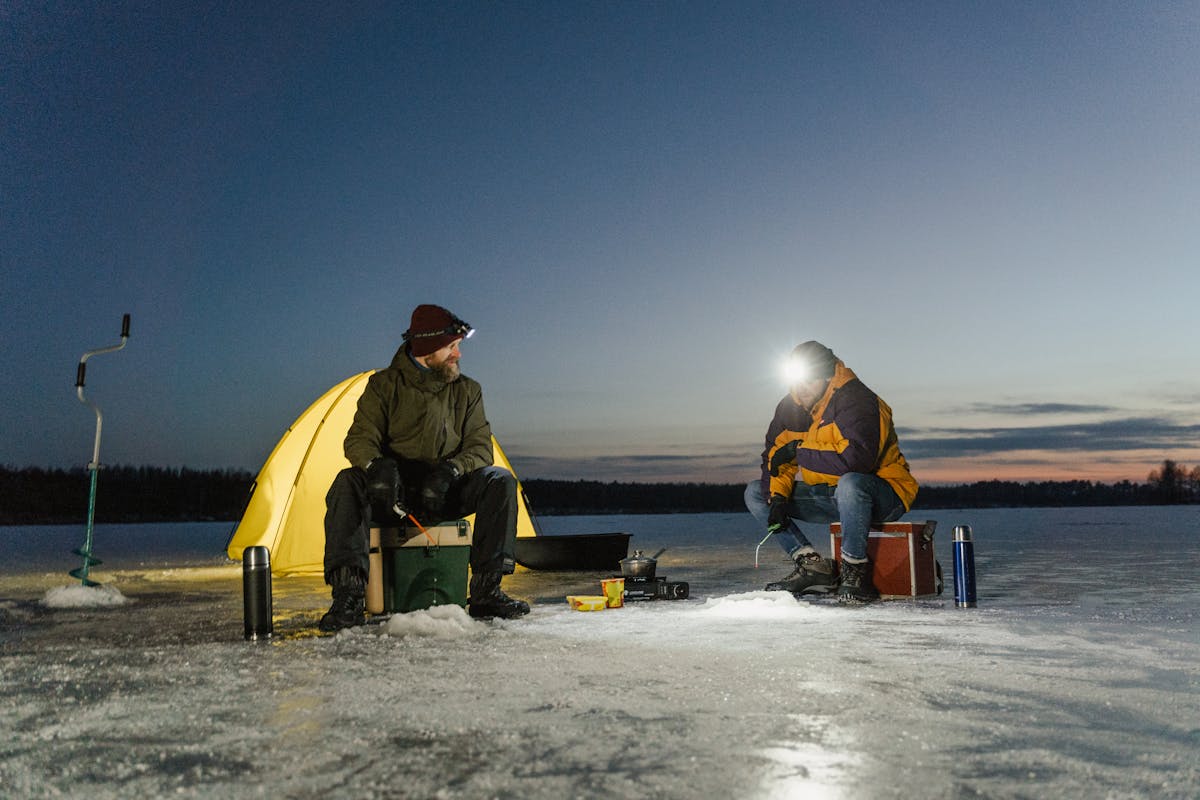
Winter transforms northern fishing entirely. Once the lakes freeze — typically November in Lapland, December further south in Norrland — the ice fishing season begins and runs through March. Ice fishing (pimpelfiske) in Sweden is practised on a scale and with a seriousness that surprises visitors unfamiliar with it. People drive snowmobiles onto lake ice to access distant fishing spots. Small heated huts are erected over holes. Entire families spend winter weekends on frozen lakes, jigging for perch, pike-perch and the ever-present perch.
I've done ice fishing in Lapland, sitting on a chair with a hot chocolate, hole drilled in the ice, waiting for movement on the line. Here's the honest version: it's cold. Genuinely cold. But there's something about the simplicity of it — the direct contract between you, the hole, the water below, and the possibility of something large deciding to take your bait — that creates an unusual kind of alert restfulness. Cold but energising is the right description. You're not warming up by huddling; you're warming up by the intensity of attention and the periodic movement required to jig the line. The hot chocolate matters more than any fishing technique.
For visitors, the ice fishing experience is accessible through virtually every winter lodge and sports shop in northern Sweden. Renting equipment (auger for drilling the hole, rod, jig and bait) costs very little, permits for most lakes are inexpensive, and the experience — sitting on a bucket over a hole in the ice with the cold pressing down and the possibility of a large pike-perch materialising from the dark water — is the kind of thing people describe for years afterwards. According to guides who run these experiences regularly, "The appeal isn't really the fishing — it's the meditative quality of sitting still in an extraordinary landscape while your body learns what real cold actually is."
Key Northern Destinations
Kalix and Tornio rivers (Norrbotten): Premier salmon rivers. Tornio is free-running and internationally significant. Permits sold through local fishing associations; some beats go by lottery.
Ammarnäs and Tärnasjön area (Lappland): Remote mountain char and brown trout fishing in wilderness that requires real effort to reach. The reward is fishing waters that see perhaps a hundred rods a year.
Ångermanälven system: Large river system with salmon and grayling. More accessible than the far north. The Junsele area has a well-developed sport fishing infrastructure.
Storsjön, Östersund (Jämtland): One of the five public lakes. Perch, pike, zander and — according to persistent local tradition — something considerably larger. The Storsjöodjuret, Sweden's equivalent of the Loch Ness monster, has been reported since the 16th century. We make no promises about that. The perch, however, are excellent.
| Species | Peak Season | Method |
|---|---|---|
| Atlantic salmon | June–August | Fly, spinner |
| Sea trout | June–September | Fly, spinner |
| Grayling | July–September | Dry fly, nymph |
| Arctic char | June–August; ice Jan–Mar | Fly, jig, troll |
| Brown trout | May–September | Fly, spinner, worm |
| Perch (ice) | December–March | Jig under ice |
Middle Sweden: The Great Lakes and Forest Pike Country
Middle Sweden — from Dalarna and Värmland in the north down through the great lake region of Vänern and Vättern, Mälaren and the Stockholm archipelago — is where the bulk of Sweden's population lives and where the most varied fishing is found. It is also where the free public fishing of the allmänt vatten lakes makes a serious difference to the visiting angler: Vänern and Vättern are among the largest freshwater bodies in Europe, they are free to fish, and they hold fish of a quality that justify the trip on their own.
Vänern: Europe's Third-Largest Lake
Lake Vänern covers 5,655 square kilometres — Sweden's largest lake and the third largest in Europe. Its size means it has distinct sub-environments: shallow reed-fringed bays in the east hold the pike and perch that most visitors target; the deep open water holds large numbers of vendace, whitefish and the occasional massive lake trout; and the river inlets (particularly the Klarälven) hold salmon that have been the subject of a long-running reintroduction programme.
The pike fishing in Vänern is exceptional. The lake's nutrient-rich bays produce fast-growing fish, and specimens of 80–100cm are caught regularly by boat anglers working the reed edges with large soft plastic lures and jerkbaits in early morning. The best pike fishing is in spring (April–May) when the fish are in the shallows post-spawn, and in late autumn (October–November) as the water cools and pike feed aggressively before winter.
Mariestad, Lidköping and Karlstad are the main bases for Vänern fishing. Boat hire is available at most harbours; local fishing guides can be found through the regional fishing association.
Vättern: The Deep Cold One
Vättern is the opposite of Vänern in almost every respect. Where Vänern is large, shallow and productive, Vättern is long, narrow and extraordinarily deep — up to 128 metres in the central sections. The water is cold and oligotrophic (nutrient-poor), and the fish reflect this: Vättern holds some of the largest lake trout (laxöring) in Europe, large populations of grayling in its tributary rivers, and the unique Vätternröding — an endemic subspecies of Arctic char that has evolved in isolation since the last ice age.
The lake trout fishing in Vättern is serious sport. Fish of 10–15kg are caught every season by trolling anglers working downriggers at depth, and the record Vättern lake trout — over 21kg — stands as a remarkable testament to the lake's cold, clear water and very slow-growing fish. Jönköping, at the southern tip, and Karlsborg, on the western shore, are the main fishing bases.
Dalarna: The Forest Lake System
The forest lakes of Dalarna are among the most productive pike and perch waters in Sweden. The lakes around Lake Siljan — particularly Orsa lake to the north and the network of forest lakes throughout the county — offer large-fish pike fishing in a landscape of red cottages, birch forests and complete summer tranquillity. The Dalälven river, which flows from the Dalarna mountains south to the Baltic, holds salmon and sea trout in its lower reaches (the Älvkarleby section near Gävle is particularly well-regarded) and grayling and brown trout higher up.
Fishing in Dalarna combines naturally with the broader Dalarna experience — the Dala horse workshops, Midsommar, lake swimming. The summer cottage tradition means that many accommodation options include direct lake access and a boat as standard. Read our Dalarna guide for the full picture of the region.
The Stockholm Archipelago
The 30,000 islands of the Stockholm archipelago offer sea fishing that is accessible from the city within an hour. Perch and pike in the inner archipelago bays; sea trout along the island shores; cod in the outer reaches; and mackerel when they push in from the Baltic in summer. The archipelago is fished year-round, but summer kayak fishing for sea trout along the granite shores — paddling between islands, casting to the seaweed edges at low light — is a particularly Swedish experience that combines beautifully with the rest of the archipelago trip. See our archipelago guide for logistics.
| Species | Peak Season | Best Location |
|---|---|---|
| Pike | Apr–May, Sep–Oct | Vänern bays, Dalarna forest lakes |
| Perch | June–September | All lake systems, archipelago |
| Zander (pike-perch) | May–October | Mälaren, Vänern |
| Lake trout | May–October | Vättern (trolling) |
| Arctic char (Vätternröding) | June–September | Vättern (deep) |
| Sea trout | September–November | Archipelago shores |
| Salmon (Klarälven) | June–August | Klarälven inlet, Vänern |
Southern Sweden: Rivers, Canals and the Sea
Southern Sweden — Skåne, Blekinge, Halland, Småland and the Baltic islands of Öland and Gotland — is warmer, more densely settled and has a fishing character shaped more by its rivers, its coast and the sea than by the deep forest lakes of the north. It is also home to some of Sweden's most storied fishing destinations, particularly the Mörrum river in Blekinge, which has been producing large salmon and sea trout for centuries and is considered one of the finest salmon rivers in the country.
The Mörrum River: Sweden's Salmon Cathedral
The Mörrum has been producing salmon for so long that the Swedish Crown held fishing rights here in the Middle Ages. Today, the river's managed beats — particularly the Laxens Hus section near Mörrum village — are some of the most sought-after salmon fishing in Scandinavia. The river is small by northern standards, wadeable for most of its length, and the fish that run it — often heavy, late-season fish of 10–20kg — are in spectacular condition after their long migration.
The salmon season on the Mörrum runs from the beginning of April through September. Spring fish are available early, but the peak for large fish is typically June and July. Day permits for the main beats are sold by the Mörrum Kronolaxfisket authority and book out quickly; a daily rod on the prime water during peak season is one of the more expensive fishing experiences in Sweden (around 800–2,500 kr depending on beat and season), but the quality justifies it. Sea trout fishing is available from September through the autumn, when large fish enter the river from the Baltic.
Helgeån, Rönneån and the Skåne River System
Skåne, Sweden's southernmost county, has a network of smaller rivers that hold sea trout year-round. The Helgeån flows through the eastern part of the county; the Rönneån is excellent for sea trout from September onwards; and the Råån near Helsingborg has an active restoration programme that is producing increasingly good autumn sea trout fishing. These are wading rivers, fly-fishing territory, in a landscape of rolling fields and beech forest that looks nothing like the rest of Sweden but has considerable charm of its own.
For pike and perch, the large lakes of Småland — particularly Åsnen (one of the best pike lakes in Sweden) and the chain of lakes through the Emån river system — are the destination. Åsnen is managed as a nature reserve and has populations of osprey, white-tailed eagle and otters alongside its pike. Fishing from a canoe or small boat through the islands of Åsnen on a calm September morning, with ospreys working the shallows and the maples turning orange, is one of the better experiences Swedish fishing offers outside the far north.
Sea Fishing: The West Coast and Baltic
Sweden has coastline on two seas — the North Sea on the west coast (via the Kattegat) and the Baltic on the east. The fishing character is entirely different on each side.
The west coast, particularly around Gothenburg and north into Bohuslän, offers real sea fishing in the Atlantic sense: cod, pollock, mackerel, garfish, and sea bass as they have moved north with warming waters. The Bohuslän archipelago has an excellent charter boat industry operating from ports including Smögen, Lysekil and Kungshamn. Mackerel fishing in summer — a light tackle, high-volume sport — is accessible from any pier and requires nothing more than a set of feathers and a basic rod.
The Baltic coast is different in character. The Baltic is a brackish sea (low salinity), which limits species diversity but favours certain fish enormously. Perch on the Baltic coast grow to exceptional sizes — 40–50cm fish are common in the archipelago systems — feeding on the abundant herring fry and small sprat. Sea trout are present year-round and reach their peak condition in autumn as they stage outside river mouths waiting for rain to trigger their upstream run. Coastal wade fishing for sea trout on the Baltic — wading the seaweed banks at dawn, casting with light spinners or small streamer flies — has developed into a significant fishing tourism sector in Blekinge, Östergötland and the Stockholm archipelago outer zone.
| Species | Peak Season | Best Location |
|---|---|---|
| Salmon | April–July | Mörrum river, Blekinge |
| Sea trout (river) | September–November | Mörrum, Rönneån, Helgeån |
| Sea trout (coastal) | Year-round, peak autumn | Baltic coast, Bohuslän |
| Pike | Apr–May, Sep–Oct | Åsnen, Emån system |
| Perch (coastal) | May–October | Baltic archipelago |
| Mackerel | June–September | Bohuslän west coast |
| Cod | May–October | West coast, Bohuslän charter |
The Coldcation Argument for Swedish Fishing
Swedish fishing is not just a sport. It is the most direct way to access the thing that makes Sweden distinct as a destination: the relationship between a cool, clear, largely unpolluted landscape and the life it supports. The water in most Swedish fishing destinations is clean enough to drink. The air temperature while you are fishing it — 15°C on a July afternoon in Lapland, 20°C in Dalarna in August — is the temperature that makes concentration possible and the body comfortable for hours at a stretch.
This is the Coldcation principle expressed in fishing terms. The best fishing in the world tends to happen where the water is cold enough to be clear and the air is cool enough to be comfortable. Sweden is that place, for most of the year, across most of the country.
And then there is the practicality: Sweden is one of the easiest fishing destinations in Europe to navigate as a visitor. Most permits are available online in English. The infrastructure — boats, accommodation near fishing waters, guiding services — is well-developed without being commercialised to the point of losing its character. The roads reach places that would require days of hiking in most other countries. And Allemansrätten means that if you find a path through the forest to a lake that is not on any map, you can cast a line in it without asking anyone's permission.